
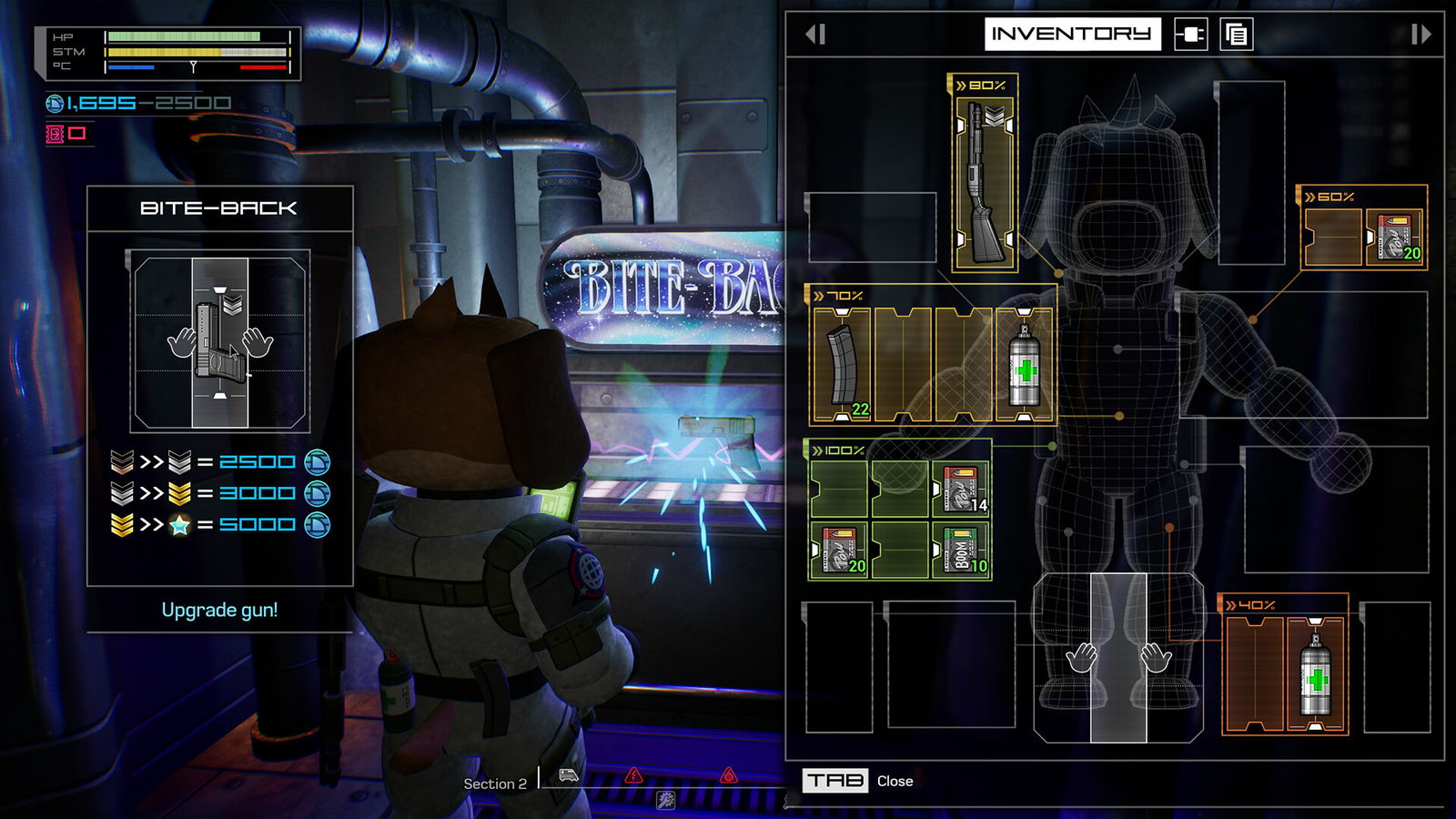
Quick answer: Credits serve multiple jobs in Fright Train: unlocking passage, buying supplies and improving weapons. Keep enough for required travel before spending on optional upgrades. A stronger gun will not help if its magazine is empty or inaccessible. Pick an upgrade to solve a weakness you can actually see in the current run rather than following an unsupported weapon ranking.
What the game confirms about the economy
The developer lists credits as the currency for unlocking cars and rooms, vending-machine purchases and weapon upgrades. The train is procedurally generated, and loot and room arrangements vary. A fixed purchase sequence based on one recording can fail when the next door or shop appears differently. Official overview.
The full-version tutorial also presents item slots, quick equipping and manual magazine loading. This makes weapon choice more than looking at a damage number. Before buying an unfamiliar gun, check whether you know which ammunition it uses, whether you have a viable magazine and whether it fits your available carrying slots. Launch footage, Wanderbots 2:00.
Decide what to buy with three questions
- Can I pay the next required passage cost? If not, the route has priority. Collect more credits before an optional upgrade.
- What is my current failure mode? Running dry suggests an ammo and magazine problem; dying at the start of waves suggests preparation or survivability; missing too often suggests learning the weapon before upgrading its output.
- Will this purchase be usable before the next event? Buying a weapon that needs different ammunition when the tracker is nearly complete may create a new problem instead of solving the old one.
These are transparent prioritization questions, not a secret in-game formula. Costs and weapon stat tables are not published here because we have not independently verified a complete release-build set.
A usable shopping matrix
| Current situation | Check before purchase | Practical choice |
|---|---|---|
| You cannot afford the next door | Door’s actual displayed cost | Preserve credits and collect nearby earnings |
| You own bullets but cannot shoot | Gun, compatible magazine and loaded rounds | Solve the reload sequence before shopping |
| You repeatedly run out during storms | Spare magazines, ammo supply, access speed | Prefer reliable resupply over an untested new gun |
| You are dying to cold | Heat pad, breached windows, carriage condition | Address survival rather than buying another weapon |
| You already have passage and supplies secured | Actual item details at the terminal | Consider a weapon improvement to solve observed combat needs |
The source videos feature weapons such as the Gecko 19 and later scavenged guns, but each player’s drops differ; a name appearing in one footage file is not proof of a universally available starting store inventory.
Weapon upgrades and temporary state
The full-version recordings show a weapon upgrade opportunity and separate purchases during runs. They do not provide a complete, independently cross-checked catalogue of damage, range, attachment effects and prices. Accordingly, there is no fake “S-tier” chart here. Read the game’s current upgrade description, compare it to what you already carry and check the time until the next wave. If you cannot state what the upgrade improves from the current UI, keep the decision open.
The same caution applies to the pouch upgrade. Footage shows it increasing storage capacity, but a player’s different build or a future patch may change exact access or price. Use a pouch upgrade when inventory pressure is your real bottleneck; don’t confuse capacity with automatically faster magazine access. Full version, inventory upgrade sequence.
Testing a new weapon without sacrificing a run
Where your run permits, inspect the weapon outside an active wave. Check the magazine it accepts, load it, bind it to an accessible slot and verify you can actually swap back. Keep your prior reliable weapon or emergency option until the replacement proves usable. If the game offers a training area or easy difficulty, that is the place to learn input timing — not your first encounter with a heavily armored enemy.
For armored opponents, the developer explicitly notes that some have weak points and reactive behavior. Observe the target; don’t assume one fixed headshot rule for all opponents. The boss preparation guide covers how to approach a new encounter without inventing a damage multiplier.
Between waves: a short upgrade checklist
Have I paid or reserved for the route? Have I repaired the current carriage? Can I fire the weapon immediately? Do I understand the magazine and ammunition? Do I have a recovery item and a safe path forward? When all five are true, an optional upgrade becomes a reasonable use of leftover credits. When any is false, solve the practical risk first.
Sources: Developer press kit, Wanderbots’ release gameplay, full-release footage with upgrade interaction.
Watch the real game
FULL RELEASESource: Wanderbots. The video belongs to its creator and loads only when you choose to play.